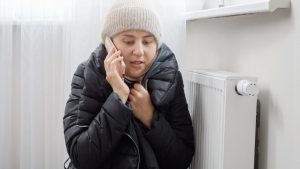
If your furnace is running but not blowing hot air, the cause is usually one of six things: a thermostat set to the wrong mode, a clogged air filter, an ignition or pilot light failure, a blower motor problem, a tripped limit switch, or leaking ductwork. Some of these you can check yourself in about 10 minutes. Others need a licensed technician. Here is how to tell the difference, and what to do next.
When the heat goes out in the middle of a Springfield winter, knowing what to check first saves you time and money. It also tells you when it is time to schedule professional furnace repair in Springfield, MO.
“No heat right now? Call us at (417) 671-3005, text (417) 804-3553, or book your service online in under two minutes. We run same day and after hours furnace calls across Springfield, Republic, Nixa, and Ozark.”
Why Is Your Furnace Not Blowing Hot Air?
Several problems can keep a furnace running without producing heat. Some are quick fixes you can handle yourself. Others need a licensed technician with the right diagnostic tools. Here are the most common issues we see in Springfield homes.
Is Your Thermostat Set Correctly?
Your thermostat tells the furnace when to run. A wrong setting is the most common reason a furnace pushes out air that never warms up, and it is the first thing our technicians check.
Check whether:
- The thermostat is set to heat, instead of fan or cool.
- The target temperature is set at least a few degrees above the current room temperature.
- The fan is set to Auto instead of On.
- The thermostat has working batteries if it uses them.
That last one catches a lot of people. With the fan set to On, the blower keeps running between heating cycles. The air it moves is not being heated, so it feels cool at the vents even though nothing is actually broken. Switch the fan to Auto, and the blower will only run while the burners are firing.
If the display stays blank after new batteries, or the furnace still isn’t responding to temperature changes, it is time for professional furnace service in Springfield, MO.
Is a Dirty Air Filter Choking Your Airflow?
A clogged filter starves your furnace of the air it needs to move. As dirt builds up, less warm air reaches your vents. Worse, trapped heat can push the furnace past its safe operating temperature, shutting the burners down mid-cycle. ENERGY STAR estimates that airflow problems alone can cut a system’s efficiency by as much as 15 percent.
Pull the filter out and hold it up to a light. If you cannot see light through it, replace it. Check that the airflow arrow on the new filter points toward the furnace, because a backward filter restricts airflow just as badly. ENERGY STAR recommends inspecting your filter once a month and changing it according to the manufacturer’s guidelines. For most Springfield homes, that works out to every one to three months, and more often if you have pets or live near active construction.

Is the Pilot Light or Ignition Failing?
Older gas furnaces use a standing pilot light, a small flame that burns continuously and lights the burners on demand. Most systems built in the last 20 years use electronic ignition instead, which creates a spark or heats a surface only when the thermostat calls for heat.
Either way, if the ignition doesn’t fire, the burners can’t light. The blower still runs, so from the hallway it sounds like the furnace is working normally. The air reaching your vents stays cold because nothing is heating it.
Don’t keep trying to relight a furnace if you are unsure of the proper procedure. And if you smell gas at any point, stop. Leave the house, then call 911 and your gas utility once you are outside.
Once everyone is safe, have a licensed technician inspect the ignition components, burners, gas supply, and safety controls. Our technicians carry the tools to test all four on the first visit, so you won’t have to wait for a second appointment to get your heat back.
Is the Blower Motor Moving Enough Air?
The blower motor pushes heated air through your ductwork and out into each room. When it fails or runs weakly, the furnace can be making plenty of heat while almost none of it reaches your vents.
Watch for these signs:
- Weak airflow from several vents at once
- Humming, squealing, or grinding coming from the motor
- The blower shutting off suddenly in the middle of a cycle
- A furnace that runs constantly but never warms the whole house
The blower assembly combines electrical and mechanical parts, including a capacitor that can hold a charge even after the power is off. This is a job for a professional.
Is the Limit Switch Shutting Down Your Burners?
Your furnace has built-in safety controls that prevent overheating. The limit switch is one of them, a sensor that shuts off the burners when the air inside the furnace climbs past a safe temperature. It is doing its job when it trips, but it leaves the blower pushing unheated air.
Closed supply vents, blocked return grilles, and a dirty filter all restrict airflow and cause that overheating. The result is short cycling, where the furnace fires up, runs briefly, shuts off, and repeats. You get short bursts of warm air followed by long stretches of cold, and the constant starting and stopping wears out parts early.
Is Your Ductwork Losing the Heat Before It Reaches You?
Sometimes the furnace is doing its job, but the heat gets lost along the way, so the air doesn’t reach the room properly.
Disconnected joints, poor seals, and crushed sections all bleed warm air into crawl spaces and attics before it ever reaches you. Return air ducts matter just as much. If they leak, the furnace pulls in cold unconditioned air and has to work harder to heat it. In older Springfield homes with ductwork running through an unheated crawl space, this is common.

What Can You Safely Check Before Calling a Technician?
Work through this list before you pick up the phone. It takes about 10 minutes, and it solves the problem more often than you would expect.
- Set the thermostat to Heat and the fan to Auto
- Raise the target temperature five degrees above the room temperature, then replace the thermostat batteries if it uses them
- Pull the furnace filter and replace it if it looks dirty
- Open every supply vent and clear furniture or rugs away from return grilles
- Confirm the furnace power switch is on, since it looks like a light switch and gets flipped by accident
- Check the breaker panel and reset the furnace breaker if it has tripped
When Should You Call a Professional for Furnace Repair?
If you have worked through the list above and the air is still cold, the problem is inside the system. Anything involving gas, electrical components, or the heat exchanger needs a licensed technician, not a second attempt.
Call a qualified HVAC technician when:
- Your furnace runs but never produces hot air
- The burners will not ignite, or the pilot light will not stay lit
- It short cycles, turning on and off every few minutes
- You hear rattling, squealing, booming, or grinding
- Airflow is weak or uneven from room to room
- You notice a burning, musty, or sulfur like smell
- The house never reaches the temperature you set
We are the team at White Plumbing Company, and we have kept Springfield homes warm since 1989. We handle furnace repair across Springfield, Republic, Nixa, Ozark, Brookline Township, and the rest of Greene and Christian County, with same-day and after-hours service when your heat cannot wait. Call us at (417) 671-3005, text us at (417) 804-3553, or book your service online in under two minutes.
When Is a Furnace Problem an Emergency?
Most furnace problems can wait until morning. A few cannot. Call for emergency service right away if you smell gas, see smoke or sparks, hear a booming sound when the burners light, or your carbon monoxide alarm goes off.
If you smell natural gas, leave the building before you do anything else. Do not flip light switches, unplug appliances, or use your phone indoors, because a spark is all it takes. Call 911 and your gas utility once you are safely outside.
Carbon monoxide deserves its own mention. The U.S. Consumer Product Safety Commission reports that more than 200 people die each year from unintentional, non-fire carbon monoxide poisoning tied to consumer products, with home heating equipment among the leading sources. If your CO alarm sounds, get everyone outside and call 911. If you do not have a CO alarm on every level of your home, install one before heating season. A furnace that doesn’t heat properly is uncomfortable. One that vents combustion gas into your living space is dangerous, and these checks protect against that.
How Much Does Furnace Repair Cost in Springfield, MO?
Furnace repair pricing in Springfield, MO depends on what failed. A thermostat swap or a flame sensor cleaning sits at the low end. A blower motor, control board, or heat exchanger sits at the high end. We give you the price before any work starts, so nothing on the invoice is a surprise.
Your final price comes down to:
- The specific part that failed
- Whether that part is stocked on our truck or has to be ordered
- Diagnostic time
- System complexity and furnace type
- Age and condition of the equipment
- When you need us, since after-hours and holiday calls carry a higher diagnostic fee
Should You Repair or Replace Your Furnace?
If your furnace is under 10 years old and the repair is a few hundred dollars, repairing is almost always the better call. Once a system passes 15 years and the repair runs into four figures, replacement usually wins on comfort and on your gas bill. Here is the rough guide we use with Springfield homeowners.
| Your situation | What usually makes sense |
| Under 10 years old, one minor part failed | Repair |
| Between 10 and 15 years old, repair costs less than about a third of a new system | Repair |
| Over 15 years old, second repair in two heating seasons | Ask for a replacement quote alongside the repair price |
| Cracked heat exchanger, any age | Replace it, since this is a carbon monoxide risk |
| Rising gas bills with uneven heating room to room | Worth pricing a high-efficiency replacement |
We will give you both numbers and let you decide. If a repair will keep your system running safely for another few winters, we will tell you that too.
Why Does Regular Furnace Maintenance Matter?
An annual tune up catches small problems while they are still small. Cleaning a worn flame sensor in October costs a fraction of an emergency call in January. ENERGY STAR recommends a pre-season checkup each fall, before the first cold snap and before contractors get booked solid.
There is a safety side too. The CPSC urges homeowners to schedule a yearly professional inspection of every fuel-burning appliance in the house, furnaces included, because cracked heat exchangers and blocked flues are how carbon monoxide reaches living space. An annual tune-up catches these issues early.
Don’t Ignore a Furnace That Is Not Heating Properly
Running a furnace that never heats puts extra strain on the blower and the heat exchanger, and the problem rarely fixes itself. If a furnace isn’t blowing hot air, act the same day. Start with the thermostat, the filter, and your vents.
If the air is still cold after that, call us. We handle everything from a quick thermostat fix to a 2 a.m. no-heat emergency, and we will tell you honestly when a repair is not worth the money on an older system.
Book Now to schedule furnace service in Springfield, MO, or call us at (417) 671-3005. Most days we can be there the same day.
Frequently Asked Questions
Why is my furnace running but not blowing hot air?
If your furnace turns on but doesn’t produce heat, a few things could be going on. Most of the time it is one of two simple things: the thermostat fan is set to On instead of Auto, or the air filter is clogged. Check both first. If the air is still cold, the likely causes are an ignition failure, a failing blower motor, or a tripped limit switch, and all three need a licensed technician.
Why is my furnace blowing cold air?
A furnace that blows cold air can be annoying, but usually there’s a reason behind it. Start with the fan setting on your thermostat, which often gets left on ‘on’ instead of ‘auto’. Set it to Auto so the blower only runs while the burners are firing. Then check the air filter, since a clogged one restricts airflow enough to trip the limit switch. If both are fine, the usual causes are a dirty flame sensor, a failed igniter, or a blower motor on its way out, and those need a technician.
How much does furnace repair cost in Springfield, MO?
Furnace repair pricing isn’t one-size-fits-all. It depends on the failed part, the age and type of your system, and whether you need us after hours. A flame sensor cleaning or a thermostat swap sits at the low end. A blower motor, control board, or heat exchanger sits at the high end. We quote the price before we start work, and an annual tune-up is the cheapest way to avoid an emergency bill.
When should I call for emergency furnace repair?
Don’t wait on emergency furnace repair if there’s a real safety risk: a gas smell, smoke, sparking, a booming sound at ignition, or a carbon monoxide alarm. Leave the house first, then call 911 and your gas utility from outside. Call us for emergency service if your heat is completely out during a freeze, since indoor pipes can start freezing within hours.
How long does a furnace repair usually take?
It all depends on what’s actually wrong with your furnace. Most repairs are done in one visit, often within an hour or two. Jobs that need a special-order part or a major component take longer. Your technician will give you a realistic timeline once the diagnosis is finished, before any work begins.